SAFARI WORLD
Safari World is a drive-in zoological park divided into two parts. The first part is Safari Park, an open zoo with wild animals. The second part is Marine Park where there are a variety of marine animals and shows.
Find the cheapest ticket here.

dream worldDREAM WORLD

Best kid’s amusement park in Bangkok.

bangkok dinner cruise

DINNER CRUISES

Embarking on a stylish dinner cruise down the Chao Phraya river.

 Chinese New Year

Chinese New Year (January or February)

Chinese New Year Festival at Bangkok Chinatown, Yaowarat Road, there are numbers of demonstrations presenting Chinese cultures such as traditional Chinese Lanterns, Kang Fu Fighting, Chinese dragon and lion dances, ancient Chinese costumes, music, and the Emperor’s recipes.

Kite Flying Festival

Kite Flying Festival (March)

In March when the wind never fails to blow and the sky is clear and bright, people go to Sanam Luang, the main ground opposite the Grand Palace, to join or watch kite flying, an activity popular in this country since ancient times. A Thai kite fighting contest is held annually.

Songkran Festival

Bangkok Songkran (13 - 15 April)

The traditional Thai New Year, joyfully celebrated citywide and countrywide with rituals of merit making, cleaning houses, honouring elders, parades of dancers and music troupes, and boat races. In Bangkok the event is held in grand-scale around the Rattanakosin Island, i.e. the Grand Palace and Sanam Luang area, and the nearby Khaosan Road. The revered Phra Buddha Sihing image will be carried to Sanam Luang to be bathed by devotees. What makes the festival most fun and interesting is water splashing.

Ploughing Ceremony

Ploughing Ceremony (May)

Presided over by the King, this ancient Brahmanic ceremony is held at Sanam Luang to mark the beginning of the planting season and to bless the farmers with bumper harvests in the year.

Loi Krathong Festival

Loi Krathong (November)

The event is observed citywide and nationwide. In the evening, people gather at the waterside to float krathong, lotus-shaped vessels lovely decorated with flowers and lit candles, as a thanksgiving and worship to the Goddess of Water. There are also fun fairs, concerts, beauty contests and other entertainment activities.

Golden Mount Fair

Golden Mount Fair (November or December)

Annually held 7 nights and 8 days (from the 11th day of the waxing moon of the 12th lunar month to the 3rd of the waning moon of the same month), the event's purpose is to worship the Buddha's relics enshrined in the Golden Mount in the compound of Saket Temple. It features folk plays, sales of foods and other products, and amusements.

* The event dates are tentative, please check before travelling.

  Location

Located in the centre of the country, straddling the banks of the Chao Phraya River and close to the Gulf of Thailand, the greater Bangkok Metropolis (including Thon Buri on the other side of the Chao Phraya River) covers an area of about 1,600 sq. km. Bangkok is adjacent to Pathum Thani on its north, Nonthaburi on its northwest, Chachoengsao on its east, Samut Sakhon on its southwest, and Samut Prakan on its southeast.

  Area

Bangkok has an area of 1,568.737 sq. km.

  Climate

There are three seasons: rainy (from June to October), hot (from March to May), and cool (from November to February). The annual average temperature is about 29° C with the monthly averages ranging from 35° C in April to 26° C in December.

  Topography

Bangkok is located in the basin of the Chao Phraya River and has no mountains. The land is crisscrossed with canals and rivers.

  Administration

As the capital of the country, Bangkok is the centre of administration, commerce and communications. The city is divided into 50 districts (khet).

  Language

The standard Thai language is in use. English, a mandatory subject in public schools, is widely spoken and understood in business and tourist areas.

  Products

Bangkok is the centre of all kinds of goods, both domestic and imported.

  Internet Access

Internet cafes are ubiquitous and hotels often have wi-fi for guests.

bt-bangkhunphrom-palace

Photo : www.bot.or.th/Thai/MuseumAndLearningCenter/BOTMuseum/Palace/Pages/default.aspx

By Ninnart

When cruising up the Chao Phraya River, passing under the Rama VIII Bridge in Bangkok, on your right you will see a splendid yellowish construction showing an awesome architecture facing the river. Also, when you cross the Rama VIII Bridge, heading for Phra Nakhon District on the east bank of the river, you will see the building as well. It is Bang Khunphrom Palace, widely known as one of the most beautiful palaces of the country.

To celebrate the 101st anniversary of the completion of this palace and for the sake of art, Thaiways presents to you a concise story about the palace.

Background

Bang Khunphrom Palace, which is now the Bank of Thailand Museum, was once the residence of H.R.H. Prince Baripatra Sukhumbhand, the 33rd son of King Rama V. The construction of the main building (or tamnak yai) was finished in 1906.

Later, another building called tamnak somdet was built to be the residence of his mother, H.M. Queen Sukhumala Marasri. Different ages of building resulted in different art styles of the whole palace. But they magically created the stunning impression for the beholders.

Architectural Styles

The tamnak yai 's art styles are Renaissance, baroque and rococo while the tamnak somdet is of art nouveau. The tamnak yai has a porch at the right wing. The walls are curved, so every other composition is curved too. Mr. Mario Tamagno was the architect in chief of tamnak yai while Prof. Dr. Karl Siegfried Dohring was responsible for the setting up of the tamnak somdet.

Bang Khunphrom Palace's main building was decorated with various but harmonious window styles, making it the palace having the most beautiful windows among the contemporary constructions.

Life at the palace in former times

At the time of Prince Baripatra, who was a scholar himself and who possessed knowledge in many fields, Bang Khunphrom Palace was the meeting centre of royalties who came to discuss political and intellectual matters. Hence, the palace was also known in the name "Bang Khunphrom University".

Because of the beauty of the palace and the sublime tastes of specialties cooked here, it also served as a banquet venue to receive royal or state guests.

At that time, the palace was famous for traditional Thai music and food. It was told that music never stopped at Bang Khunphrom Palace. And the best-known recipe was khanom-chin (rice vermicelli eaten with various kinds of curry and vegetables).

Prince Baripatra was good in several fields, particularly military, administration, art and music. Apart from being a great admiral, he was also a talented composer. He composed 73 traditional Thai and modern songs. Of these, Khaek Mon Bang Khunphrom and March Baripatra stand out. As a pioneer orchid enthusiast of Thailand, the Prince wrote the country's first book on orchids.

The turning point of the palace

Following the political transformation in 1932, Prince Baripatra and the family moved to Bandung, Indonesia, where he lived until the last days of his life.

Bang Khunphrom palace was turned into offices for several organizations. In 1945 it became the office of the central bank, and in 1992, the Bank of Thailand Museum. The museum exhibitions feature the prince's life, the history of the central bank and Thai and foreign currencies.

Bank of Thailand Museum

The museum is aimed to preserve the various forms of Thai currency since the earliest times and stimulate the research and study on the history and evolution of Thai currency. The exhibitions consist of 14 rooms such as:

Ancient Coins Room : On display are shells or beads used as money in ancient times. Visitors will learn about the introduction of coins used in the ancient kingdoms prior to the establishment of the Kingdom of Thailand such as Funan coins, Dvaravati coins and Sri Vijaya coins.

Pot Duang Room : The room exhibits Pot Duang coins which have different seals and circulated from the Sukhothai Period (1238-1438) up to the reign of King Rama V (1868-1910) of the Rattanakosin Period. Their production methods are also described.

Thai Coins Room : Thai flat coins which were initiated by King Rama III (1824-1851) are exhibited here. These coins serve as models for coins of the following periods up to the present.

Thai Banknotes Room displays the evolution of the Thai paper money from the earliest issuance of the paper money known as "mai" in King Rama IV's reign (1851-1868) through the issuance of banknotes series circulated nowadays. Commemorative banknotes issued on special occasions are collected here as well.

Gold and Commemorative Coins Room displays commemorative gold coins, silver coins, nickel coins, gold bond, as well as gold bullions which are used as currency reserves.

Bank of Thailand 60th Anniversary Room exhibits the history, the responsibilities of the Bank of Thailand and important events of the Bank in chronological order.

Baripatra Memorial Room showcases the life, works, activities and the talents of H.R.H. Prince Baripatra Sukhumbhand.

To admire the beauty of the palace, visitors are welcomed in groups only. The admission is free. Photography is not permitted inside the museum. Please contact the museum one week in advance of the intended visit.

Opening hours : Monday - Friday 9:30 a.m. - 4:00 p.m.

Tel : 0 2283 5286, 0 2283 6723

E-mail : This email address is being protected from spambots. You need JavaScript enabled to view it.

Address : 273 Samsen Road, Bang Khunphrom, Bangkok, 10200

Buses to museum : No. 3, 9, 30, 32, 33, 43, 64, 506

For the correct pronunciation of romanized Thai words, see Romanization System of the Thai Language.

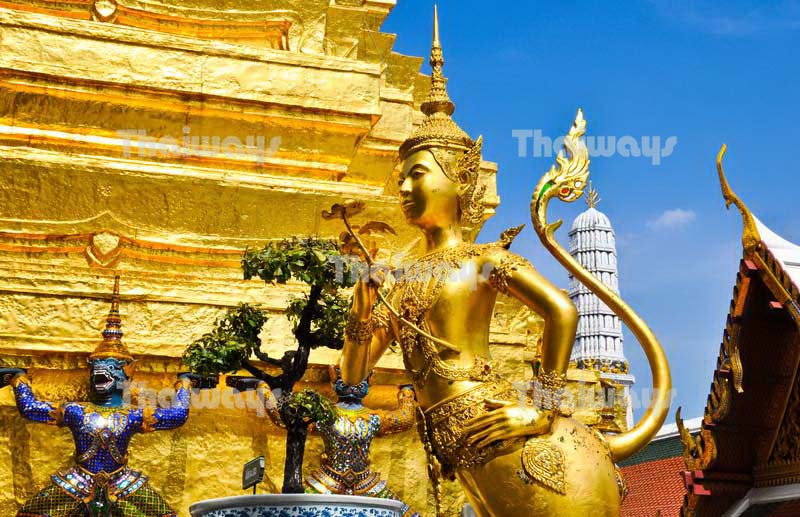
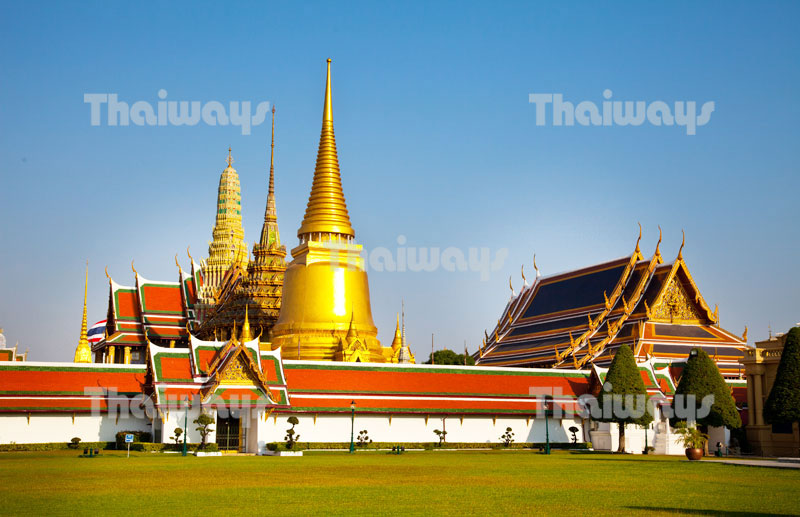
The Grand Palace with its Royal Chapel (i.e., the Temple of the Emerald Buddha or Wat Phra Kaeo) is the place most frequented by foreigners. It was built after King Rama I ascended the throne as the founder of the Chakri Dynasty on 6 April 1782. He moved the capital from the west to the east side of the Chao Phraya River.

Then the King ordered the construction of a permanent palace together with a royal chapel to house the Emerald Buddha, which the King himself had recovered from Vientiane during the reign of King Taksin.

The Grand Palace and the Temple of the Emerald Buddha, occupying an area of 152 rai (i,e., 243,200 sq m or 60 acres) and surrounded by walls with battlements, have subsequently undergone many changes.

Old buildings were pulled down and new ones added. Only the middle part, where are situated the four groups of palace buildings named, from west to east, the Dusit Maha Prasat, the Chakri Maha Prasat, the Maha Monthian and the Boromaphiman Hall, will be described here.

One of the important buildings here is the convocation hall, called Ubosot inThai, where the Emerald Buddha, the most revered statue of Thailand, is enshrined on a high altar.

To the north of the convocation hall there is a higher terrace on which three important monuments, viz. the Royal Pantheon, the Mondop and Phra Si Rattana Chedi line up from east to west. Rivercity

Scattered in the temple grounds are numerous interesting sculptures of artistic value, including the fanciful animals in mythology on the terrace, the fierce-looking giants standing guard at the gates, the six pairs of Cambodian-style bronze lions in the front and at the back of the convocation hall, the stone figures from China, and the rows of colourful carved monkeys and demons placed along the bases of the pagodas as if to bear the weight of the structures.

Now let us go round the galleries which are the inside walls of the surrounding corridors, to admire the mural paintings which depict the story of Rama according to King Rama I's version of Ramakian (which was adapted from the Indian epic the Ramayana). There is a total of 178 connecting scenes starting from the right side of the northern gate facing the Mondop and going clockwise.

Going to the palace compound through the southern gate of the temple, you will see the four groups of buildings mentioned above. The one at your left is the Boromaphiman Hall, which was built by King Rama V for Crown Prince Vajiravudh as his residence. The next two kings also resided here. However, His Majesty the present King Bhumibol, moved to the suburban Chitralada Palace. The Boromaphiman Hall is now used to accommodate guests of the King and is inaccessible to the public.

Of the three other groups of palaces, the middle one, the Chakri Maha Prasat, was erected by King Rama V as his own residence. The 3-storey building is a mixture of Thai and Western architecture. The top covering is pure Thai with tapering spires and tiered sloping roofs, and the lower parts, designed by a British architect, are in the Imperial Victorian style. Only the ground floor is used now, the two wings for state banquets and the middle throne-hall for receiving foreign envoys on the occasions of the presentation of their credentials.

The other two, the Dusit Maha Prasat and the Maha Monthian, were among the earliest edifices constructed at the founding of Bangkok as capital. They are in the traditional Thai style modelled on the palaces in Ayutthaya. The Dusit Group at the western end was formerly used partly as an audience hall and partly as living quarters. The Maha Monthian to the east of the Chakri Group consists of three main adjoining buildings. They are, from the inside, the Audience Hall of Amarin where ceremonies of the court usually take place, the Phaisan Hall where the coronation of a monarch is held, and the Chakkraphat Phiman which was the residence of the first three Chakri kings and in which the later kings spent at least one night after the coronation.

Due to the limited space, the elaboration of the Grand Palace and the temple of the Emerald Buddha will end here. Nevertheless the impression you get from this visiting will never end.

Subcategories

Thailand is now operating two airports in and just outside Bangkok. Suvarnabhumi is the newly opened airport, located in Samut Prakan Province. Airport codes for Suvarnabhumi and Don Muang are BKK and DMK, respectively.

Passengers who have to connect their flights between Suvarnabhumi and Don Muang Airports, should allow at least 50 minutes to travel (it can be 1-2 hours depending on traffic). The distance between the two airports is about 40 km by using the expressway. The metered taxi will cost around 400-500 baht (depending on traffic), including expressway tolls and 50 baht surcharge on the meter.

THE LANDMARKS OF BANGKOK TOUR

MORE

The Landmarks of Bangkok Tour

The program including 4 temples and 1 palace: Wat Arun (The Temple of Dawn), Wat Benchamabopith (The Marble Temple), Wat Trimitr (The Golden Buddha), Wat Pho (The Temple of Reclining Buddha), The Grand Palace & The Temple of the Emerald Buddha (Wat Pra Kaew).


DAMNOEN SADUAK FLOATING MARKET

MORE
damnoen saduak floating market

Damnoen Saduak Floating Market Tour

This authentic floating market is one of the most photographed places. It is located in Ratchaburi, about 100 km from Bangkok. Take a long-tail boat to the Floating Market where you will see the lifestyle of Thai people along the canal. Many vendors floating in their small rowing boats selling local food.


logoAlex Holiday is a Bangkok-based travel agent, operating tour services and providing hotel reservations all over Thailand. We specialize in cultural, trekking, adventure and golf tours as well as other tailor-made tour packages. We can organize all kinds of travel for you. More details...


PATTAYA

MORE

Pattaya Beach

Pattaya Beach is divided into the north, central and south zones. The beach offers excellent facilities for watersports enthusiasts of all kinds.


PHUKET

MORE

Patong Beach

Patong is the most famous beach in Phuket. With its wide variety of activities and nightlife, it is an ideal place to relax, party and play.


SAMUI

MORE

Chaweng Beach

This 7-km beach is the longest and the most popular beach on the east coast of Ko Samui. It has clean white sand and clear blue water.


HUA HIN

MORE

Hua Hin Beach

A popular beach destination about 3-hour drive from Bangkok. Its long sandy beach with a relaxed atmosphere is great for family holiday.